Article
If you have ever wondered how UK research funding works, you are not alone.
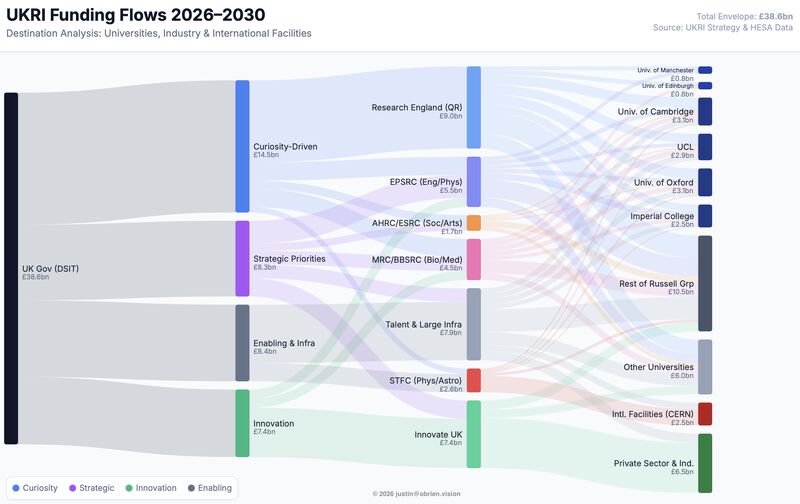
Originally posted on LinkedIn on February 2, 2026.
If you have ever wondered how UK research funding works, you are not alone. Many people (including those who apply for it) still picture a benevolent pot of money being poured directly into a lab by a person in a hi-vis jacket with a cement mixer 🦺 Reality is more “multi-stage plumbing system”, with occasional moments of “we are pausing some programmes because the spreadsheet has started colouring itself red” 🚰📉 That is the context for UK Research and Innovation (UKRI)’s recent update on paused competitions and a shift to three big “buckets” (curiosity-driven, strategic priorities, and innovation), plus the slightly spicy situation at the Science and Technology Facilities Council (STFC) 🌶️ The image I am sharing is a map I made of the flows across the 2026–2030 Spending Review period: an expected £38.6bn delivered via the Department for Science, Innovation and Technology (DSIT) to UK Research and Innovation (UKRI), then out through councils and mechanisms, and only then to end destinations 🗺️💷 Two bits tend to surprise people. First, a lot of “university research funding” is not a grant you apply for at all. It is block funding (QR) routed via Research England, heavily shaped by REF outcomes and formulae that planning offices know far too well 🧮 Second, “innovation” funding is not “universities + buzzwords”. Much of Innovate UK’s spend lands in business and industry partnerships, not in universities’ core research lines. 🏭🤝 And then there is the quietly large slice that is neither: international facilities and big science infrastructure (subscriptions, exchange rates, energy costs, and other ways to explain the eye-watering cost of experimental physics) 🔬⚛️💸 So when something gets “paused”, it is rarely as simple as “government stops funding research”. It is more often about commitments already made, headroom, timing, and which part of the plumbing is currently under pressure. But here is the hard bit: if you do not understand the plumbing, you cannot tell the difference between “a temporary jam” and “structural damage”. And right now, the people who pay the price first are not abstract ‘programmes’ or ‘portfolios’—it is researchers on fixed-term contracts, PhD students with clocks ticking, and labs that cannot just “pause” without quietly breaking ⏳🧪 If we want the UK to stay good at research, we should probably stop treating research funding as a nice-to-have that can be put on hold whenever the numbers get awkward. Because you can only run a world-class research system on world-class certainty—not on vibes and emergency spreadsheets 🧯📊