Article
Every era had its “obvious” degree.
Originally posted on LinkedIn on November 18, 2025.
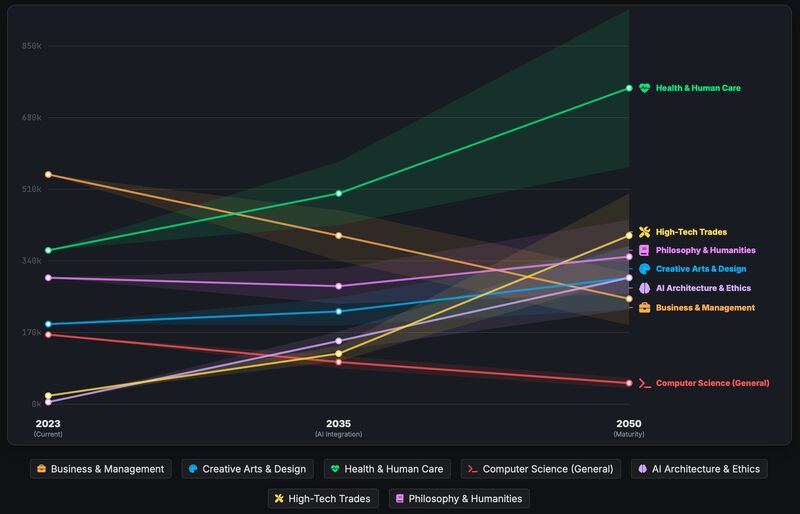
Every era had its “obvious” degree. In 1350, you studied theology to save your soul. In 1850, you studied classics to run the Empire. In 1995, you studied business to get a nice office and a pot plant. 🌿 Look at the long-run data and a pattern emerges: whenever power and labour demand shift, the subject mix shuffles along behind. Theology fades as the state secularises. Science and engineering surge with the White Heat of Technology. Business and social sciences ride the wave of mass higher education and white-collar expansion. Today, the “sensible” choices are business, generic social sciences and computer science. Prospectuses are packed with confident claims about employability, graduate salaries and “future-proof skills”. But if AI really does eat a big chunk of routine office work and entry-level coding, those assurances start to look distinctly 20th-century. 🤖 It is not that business or computing vanish. It is that the growth edge may lie elsewhere: health and human care, hybrid “high-tech trades” that live in the physical world, and a smaller number of deep, systems-level AI architecture and governance roles. The danger is that we keep shovelling students into narrow, generic programmes while under-investing in the messy, relational and physical work that AI finds hardest. If you are signing off new programmes, estates plans or staffing models, it may be worth asking: which of our current “safe bet” degrees will look most like 1850s theology in thirty years’ time – still on the books, but no longer where the action is? 🔍 What in your institution’s portfolio feels quietly misaligned with the AI stories you tell students today? The chart shows my speculation: By 2050, fewer students will opt for Business while Health and Human Care will reign supreme. #HigherEducation #AIinEducation #CurriculumDesign #GraduateEmployability #EdTech #FutureOfWork #UniversityLeadership